
What's New is Old; What's Haute is Cold
The Ice Cream Renaissance: Micro-Luxuries, Fashion Pop-Ups, and the K-Shaped Scoop


The first competition I ever took part in was an ice cream competition. A supermarket had just opened in our neighbourhood. It stood out from the row of grocery shops with their sacks of dried goods and their small selection of fresh vegetables.
The new supermarket was air-conditioned. It was brightly lit with strips of fluorescent lights and its aisles were filled with colourful goods in shiny packaging.
The competition was based on speed, rewarding the quickest eater amongst us. I stood in a line of five or six other children, holding the ice cream cone in my hands. The thing is, I wasn’t there to win. I was there for a free Cornetto which I’d planned on savouring in my own sweet time.
A Cornetto was always a treat. Although, if I were completely honest with myself, it never really lived up to its promise. The cone was always soggy—a texture I detest and yet, it always felt like a luxury to have one.


Compared to the push-up pops that were more common, a Cornetto seemed more sophisticated. These long plastic tubes were filled with either juice, rose syrup, Milo (a chocolate malt drink) and assam (tamarind), then knotted and frozen without labels.
Another everyday option was ais potong. These ice lollies were usually made with coconut milk and flavoured with pandan, adzuki beans, corn and taro, then frozen and cut into cuboids. I was unaware of how close ais potong was to the water ices popular in Georgian, Regency and Victorian England.
Icy Cream
Ice cream making in the beginning was an act of alchemy. It had just been discovered that salt lowered the freezing point of water through a process called freezing point depression. A lot of ice cream making in the early days were experiments to find the perfect ratio of ice, salt and sugar.
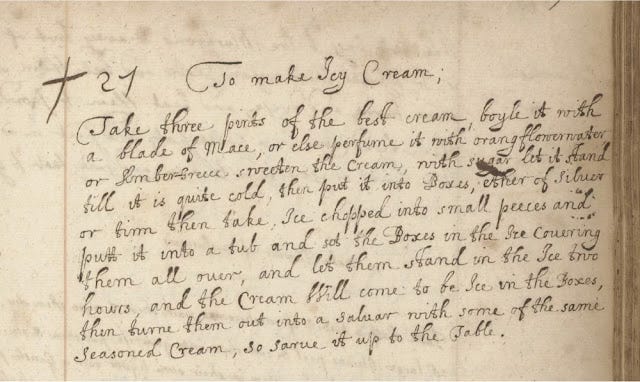
Mary Eales is often credited as the first person to share a recipe for ice cream. But before that, Lady Anne Fanshawe had handwritten a recipe in her book1. The recipe called for three pints of the best cream as a base, sugar, chopped ice and a blade of mace, orange flower water or ambergris (a substance used in perfume but is produced in the digestive tract of sperm whales and is widely known as whale vomit!) for flavouring. The recipe was unfortunately flawed because it was missing the magic ingredient that is salt; so no icy cream was formed.
The 18th Century is known as the golden age of ice cream. By 1768, the first book entirely devoted to ice cream was published by a Monsieur Emy. This was a time of flavour experiments and Emy is reportedly the first to make rye bread ice cream. He also made truffle ice cream, advising that it was best to cook the truffle in water and salt first before grounding it and mixing it with cream2.
What is especially striking about so many books and accounts of ice cream making at the time is the startling range of flavours that were accommodated. It is not just the vast range of fruits that draw the eye, but flavours like tea, coffee, chocolate, ginger, champagne, rum, brown bread, not to mention all kinds of nuts. Brown bread ice, according to The Pytchley Book of Refined Cookery, consisted of half a pound of stale brown bread crumbs mixed with a pint of whipped cream, six ounces of sugar and flavoured with vanilla essence.
Michael Freeman, Ice Blocks from Norway: The Importation of Natural Ice to Britain, Circa 1870 - 1925
It was not unusual for something like lavender ice cream to be served in the shape of a skull. Ice cream was always moulded into different shapes, creating a trompe l’oeil effect and then ceremoniously brought to the table during banquets. They were showstoppers and always the highlight of the meal.


The production of the dessert went hand in hand with the import of sugar throughout the 18th century. Ice cream had become available to more echelons of society partially due to the decrease in the price of sugar, which was a direct result of the transatlantic slave trade. This disturbing episode of history saw enslaved people treated as objects, and commodities treated as kings. Primarily sugar, but also tobacco, coffee, cotton and rum. This undercurrent of ice cream history is something that is uncomfortable to incorporate into the narrative, but for every grand banquet full of sculptural ices and for each ice cream shop offering icy treats, there was a very different diorama happening in the bows of ships and the cane fields of the Caribbean.
Tasha Marks3
The popularity of ice cream trickled down the social classes and by the late 1800s, it was not unusual for middle class homes to serve flavoured ice creams, water ices and sorbets for dessert.
The earliest reference of a cone was mentioned in entrepreneur and innovator, Agnes Marshall’s Book of Cookery. The “cornet” which was made with ground almonds was filled with ice cream but still eaten with a fork and knife. Agnes did more than invent the cone. She invented and patented Marshall’s Patent Freezer which was able to freeze a pint of ice cream in less than five minutes. She also invented an ice-breaking machine and an ice cave (an insulated box for storing ice cream). She wrote and self-published The Book of Ices, a recipe book containing 177 ice cream and dessert recipes!
So Vanilla
Ice cream evolved from the experimental spectacles of the Victorian times into a treat enjoyed by many. The convergence of the commercial ice cream production and the mass production of synthetic vanillin made this cold treat available to everyone.
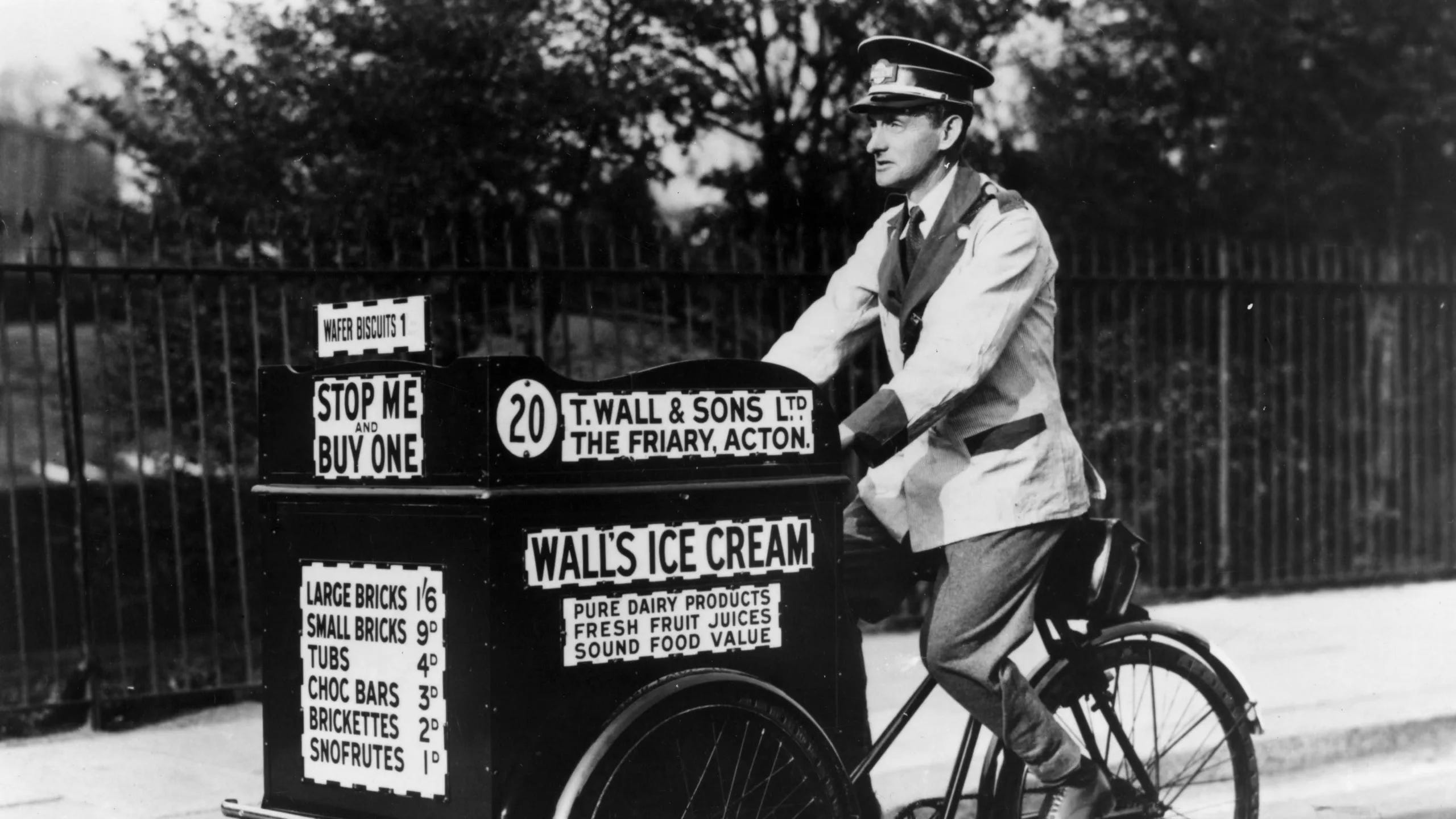
In 1922, the company T. Wall & Sons (now known as Wall’s) pivoted from making sausages to producing ice cream during the hot summer months. They sold it using ten company tricycles plastered with the slogan “Stop me and buy one”. By 1939, T. Wall & Sons had 8,500 tricycles on the road.
If the 18th Century was the golden age of ice cream, are we now living through its Renaissance?
Artisanal, small-batch brands experimenting with what appears to be “new” flavours like olive oil, hot honey, shiso leaf and parmesan have been snowballing since the pandemic. Historically, ice cream was for the extremely wealthy and served during elaborate banquets; today it is a sweet that can be accessible by almost everyone.
As global temperatures continue to rise, so have ice cream sales. During the recent heatwave, sales have nearly doubled compared to last year, making it the perfect moment for Vittles to publish its Ice Cream Guide 2026 by Ruby Tandoh.
Geopolitical conflicts and persistent inflation have formed new consumer habits. Ice cream is now considered a “micro luxury” and experiencing the lipstick effect.
This reflects a fragmented consumer divide where customers with more disposable income are buying premium ice cream and the lower-to-middle income families experience food insecurity. A distinct K-shaped economy is observed within the ice cream industry where mass market brands are trapped in the precarious middle ground and in danger of melting into oblivion.
Haute and Cold


Luxury brands have been quick to spot this and see ice cream as an experiential and social-media friendly opportunity. Bottega Veneta and Loewe have pop-up ice cream bars in London to launch their new fragrance and candle. Meanwhile, in NYC, Acne handed out free ice cream and perfume samples at their Prince Street to celebrate the launch of Acne par Frédéric Malle’s body wash and body milk.
The intersection between food and fashion continues to churn. Ice cream is an easy win for brand marketing: everyone loves it and it photographs beautifully. Ice cream easily transforms traditional retail into a multi-sensory experience. It is playful and nostalgic, evoking the feeling of a holiday and happy memories.

Anya Hindmarch was a scoop ahead when she launched The Ice Cream Project in 2022 turning ordinary supermarket brands to unique flavours. This year she launched flavours like OXO stock cube, Paxo stuffing to more palatable offerings like Lurpak butter, Tunnock’s Caramel Wafers and Mcvitties Ginger Nuts.


If ice cream is the new lipstick should it be considered an investment? If lipstick lasts only a moment on your lips, the effects of ice cream are surely more permanent—staying right on the hips! Nevertheless, nothing’s going to stop me from indulging in more frozen treats this summer.
Ivan Day, Lady Anne Fanshawe’s Icy Cream, Food History Jottings
Jeri Quinzo, Asparagus Ice Cream, Anyone? Gastronomica
Tasha Marks, Ice Cream: The Inside Scoop, The British Museum
I love the photo of you! Why am I not surprised you entered an ice cream competition?
I didn't have the first clue about any of this. And ais potong - I had to Google that, it's one of those many childhood words that are familiar but forgotten. Thanks for the reminder.
🍦 🩷